
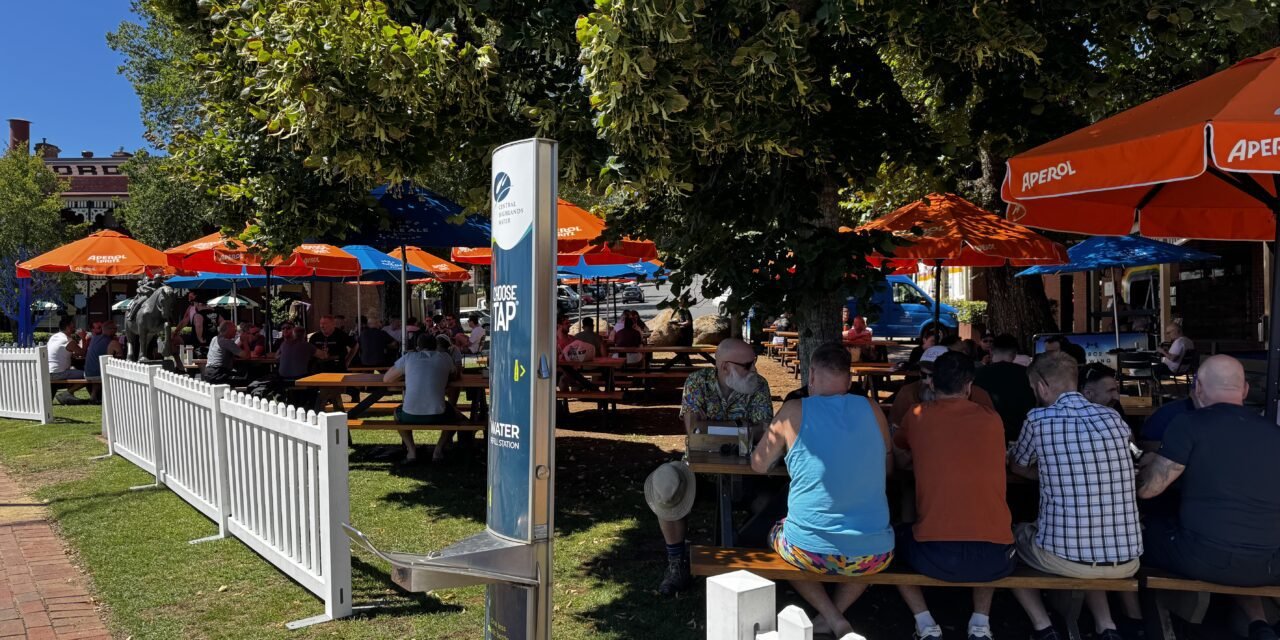
Outdoor dining has become one of the defining features of Hepburn Shire’s town centres. From Vincent Street in Daylesford to the village streets of Trentham, Creswick and Clunes, tables spilling onto footpaths create an atmosphere that attracts visitors and supports the local hospitality economy. But as outdoor dining expands, questions are increasingly being raised about how much businesses should pay to use public space.
Several residents have contacted the Wombat Post expressing concern about the growing footprint of outdoor dining areas and their encroachment into shared public areas in Daylesford. While few dispute the vibrancy that outdoor dining brings, some are asking whether the current fee structure fairly reflects the commercial benefit businesses derive from using footpaths and public land.
At present, Hepburn Shire Council charges businesses an annual permit fee for outdoor dining under its Outdoor Dining and Trading schedule. The fees are relatively modest and are based on broad seating categories rather than the actual number of seating positions.
For the 2025–26 financial year, the fee schedule is :
- Tables and chairs (up to six seats): $195
- Tables and chairs (7–12 seats): $357
- Tables and chairs (13 or more seats): $592
- A-frame signage: $100
- Umbrellas, heaters or planter boxes: $92 per item
While these charges provide a simple administrative framework, critics argue that they do not adequately account for the scale of some outdoor dining operations. In recent years several venues have significantly expanded their outdoor seating capacity. Examples often cited include large hotel venues where outdoor areas can add dozens — or even more than a hundred — additional patron seats.
Under the current system, a venue with a small number of tables may pay a similar permit fee to a much larger venue occupying far more public space. This has led some residents to suggest that the Shire should consider adopting a per-seat charging model instead.
A Seat-Based Approach
Under a seat-based system, businesses would pay a clearly defined annual fee for each outdoor seat placed on public land. The principle is straightforward: the more seats a venue places on a public footpath/area, the greater the commercial benefit derived from that public space — and the greater the contribution to maintaining it.
Supporters of the idea argue that such a system would offer several advantages.
First, it would create greater transparency. Instead of navigating tiered fee brackets, businesses would know exactly how their permit cost is calculated.
Second, it would improve fairness between small and large operators. A small café with four or six outdoor seats would pay proportionally less than a venue operating dozens of seats on the street.
Third, a per-seat system could encourage better design and efficient use of space, helping maintain clear pedestrian pathways and accessibility.
Alcohol and Outdoor Dining
Other Councils place a surcharge/premium on outdoor seats used by licensed premises serving alcohol.
The rationale is that venues serving alcohol generally generate higher revenue per seat than cafés or takeaway venues. Alcohol service can also involve longer patron dwell times and may require additional regulatory oversight related to compliance, noise management and evening activity.
Supporters argue that a modest surcharge would simply recognise these additional impacts and benefits, rather than penalise licensed venues.
Looking to Other Councils
A seat-based or itemised charging approach is not unprecedented. Several Victorian councils already charge businesses according to the number of tables, seats or other items placed on footpaths.
For example, City of Yarra Council in Melbourne operates a footpath trading permit system where individual items are priced separately. For the 2025–26 financial year, seats used by licensed premises are charged at $87 per seat per year (while non alcohol seats are charged at $27 per seat), while tables larger than 800 mm are charged $107 each.
Applying those rates provides an illustration of how a seating-based model scales with venue size.
If a venue such as the Royal Hotel in Daylesford which currently operates an outdoor dining area with approximately 20 tables, each with six or more seats, the annual cost under Yarra’s pricing model would be roughly:
- 20 tables × $107 = $2,140
- 120 seats × $87 = $10,440
This would produce a total annual permit cost of approximately $12,580. – compared to $592.
It is worth noting that the cost per seat is equivalent to one pot of beer per month.
The example is not intended as a direct proposal for Hepburn Shire, but rather to demonstrate how other councils link fees more directly to the scale of outdoor seating.
Community Benefits
Advocates for reform argue that if Hepburn Shire adopted a seating-based model, any additional revenue would be outside the rate cap and could be directed toward improvements that benefit the entire community.
Potential uses might include:
- Town centre streetscape upgrades, including improved paving, lighting and landscaping. Possibly a public toilet upgrade
- Accessibility improvements to ensure footpaths remain safe and usable for people with mobility challenges.
- Enhanced cleaning and waste management, particularly during peak tourism periods.
- Support for local events and festivals, which in turn benefit hospitality businesses.
In this way, outdoor dining fees could become a mechanism for reinvesting in the very public spaces that help drive the local tourism economy.
Balancing Vibrancy and Public Space
Outdoor dining has undoubtedly contributed to the character and success of Daylesford. Visitors often cite the lively café and restaurant culture as part of Daylesford’s appeal.
But as these spaces expand, councils face the challenge of balancing economic vitality with the shared nature of public land.
Footpaths must remain accessible for pedestrians, including families with prams, elderly residents and people with disabilities. Public spaces such as Burke’s Square are very important and their use needs to be monitored and protected. At the same time, hospitality businesses rely on attractive street environments to attract customers.
A more proportional fee system could help strike that balance — ensuring businesses that benefit most from public space contribute fairly to its upkeep.
Outdoor dining is now firmly embedded in the identity of towns such as Daylesford. The debate is not about whether it should exist, but about how it should be managed.
As Hepburn Shire continues to develop as a tourism destination, the question for the community and council alike is whether the current fee structure remains the best model — or whether a more transparent, seat-based approach could better serve both business and residents in the years ahead.


