
Hepburn Shire Council’s standing with its own community has fallen to its lowest point in ten years, according to the 2026 Local Government Community Satisfaction Survey released today — and the survey’s own numbers leave little room for a reassuring reading.
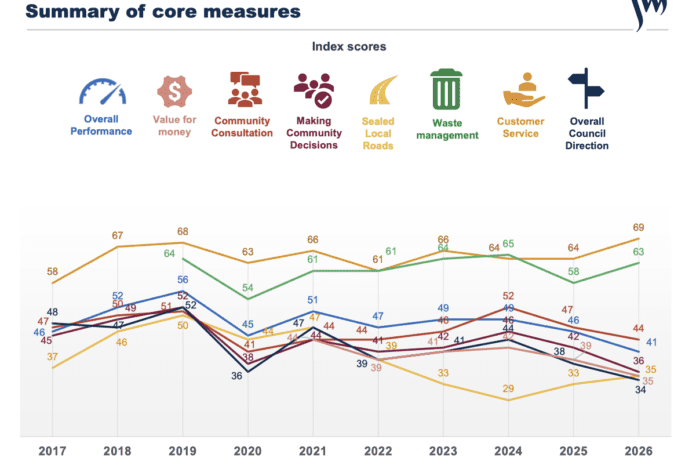
The Council’s overall performance score came in at 41 out of 100, down five points from 46 last year. To put that figure in context, the average score for comparable small rural councils across Victoria was 60, and the statewide average across all participating councils was 57. Hepburn now sits roughly 16 to 19 points adrift of the pack — not lagging, but in a different tier altogether.
This is not a one-off stumble. The report records it as the second consecutive year of decline. Before COVID, Hepburn was scoring in the 10 to 15 points higher on overall performance, much closer to the performance of other small rural councils. COVID saw a sharp dip and then a recovery. Since then the line on the graph has been heading in one direction, and this year it fell to its lowest point in the ten years measured.
The numbers are real, not noise
The five-point fall is not a statistical wobble. The survey’s methodology doesn’t allow it. The survey was conducted by JWS Research using computer-assisted telephone interviews with 400 randomly selected residents — the same robust random-probability method used to track council performance across Victoria every year since 1998. The maximum margin of error on a sample of 400 is plus or minus 4.8 percentage points at the 95 per cent confidence level. A five percent drop in a year is beyond the margin.
The good and the bad
The summary of core measures from the report in the figure accompanying this story shows the good and the bad. Frontline services are largely fine. Customer service stands at 69, the highest in ten years, and is the one measure on which Hepburn rates on par with both its small rural peers and the statewide average. Waste management has also held up reasonably well. Satisfaction with performance on sealed local showed a slight, non statistical improvement, but remained low at 35.
The collapse in satisfaction with Council sits mainly with the governance-and-trust measures:
- Value for money: 35 (down from 39, and a statistically significant fall)
- Overall council direction: 34 (down from 38)
- Making decisions in the community’s interest: 36 (down from 42)
- Community consultation and engagement: 44 (down from 47)
- Lobbying on the community’s behalf: 41 (down from 45)
Every one of these governance-and-trust measures fell this year.
A question of trust
The survey was not designed identify the specific factors that have led to an erosion of confidence. However, in Daylesford, it is likely that issues such as the mismanagement of the Rex, the failure to delivery a community hub, perceived lack of support for the very popular cinema development, the Counci’ls fragile financial position, rate increases, and recent accusations against senior Council officers have contributed to the declining levels of satisfaction with decision making.
There is also a striking generational split running through every measure. Residents aged 65 and over consistently rate the Council more favourably; those aged 35 to 49 — working-age residents raising families and running local businesses — are its harshest critics. On overall performance, the gap between the most and least satisfied age groups is wide. A Council whose strongest support comes from its oldest residents and whose deepest dissatisfaction sits with its working-age ratepayers has a sustainability problem worth taking seriously. (It is worth noting that the youngest age brackets carry larger margins of error owing to smaller sub-samples, so those figures should be read as indicative rather than precise.)
What now?
The report’s own recommendation is blunt: improving communication, transparency and advocacy, and addressing concerns around planning and road maintenance, will do more to lift the Council’s standing than anything else.
Clearly the Council needs to rebuild trust. The genuine bright spots — a ten-year high on customer service, a significant lift in waste management — show the organisation is capable of doing things well and being recognised for it.