Ryan Kennedy
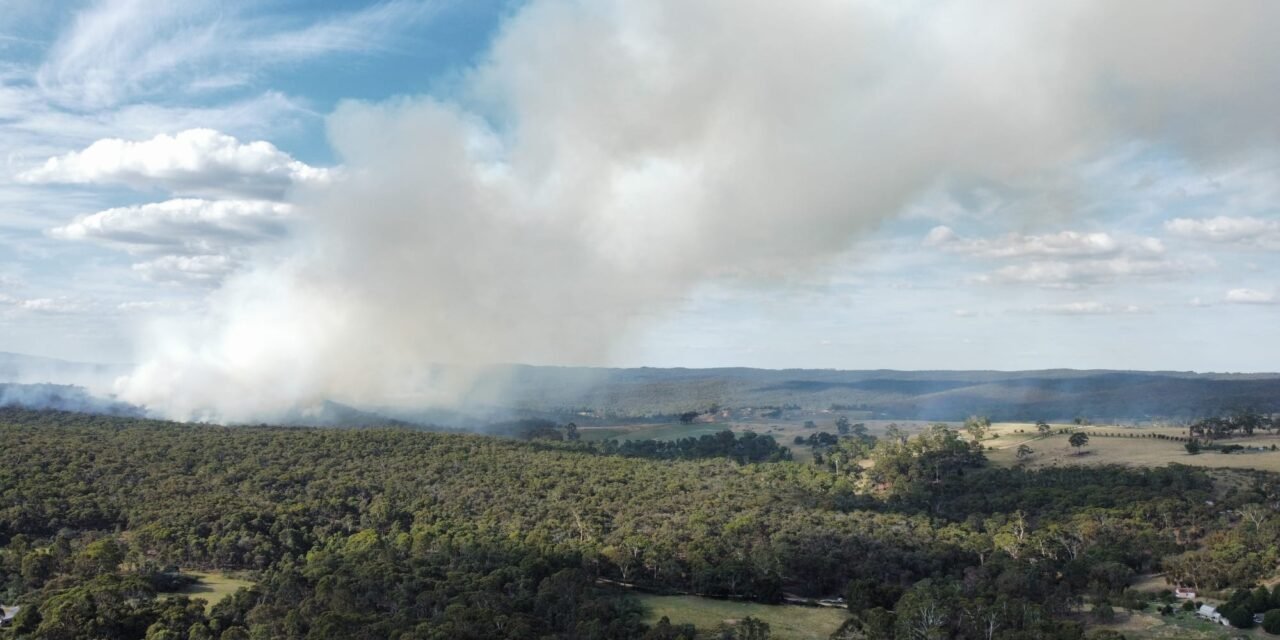
Since last year, Forest Fire Management Victoria has been teasing the bush down my way—what I lovingly call the Breakaways, both as a social and geological reference. Signs of a coming back burn appeared nearly two years ago, leaving trace indications that something might happen. Last year we were ready, but when the expected date passed, we assumed so had our chances. Then, twelve months later, the signs returned—literally everywhere: on trees, in post boxes and at driveways, as well as big road signs and even our very own large flashing yellow LED board.
The time was now, and now meant the last two weeks of March 2026. Trucks rigging, chainsaws felling, bulldozers dozing, and people in green boiler suits running amok became the daily backdrop.
I quickly passed the information on to others nearby. Being somewhat fire conscious, and never having been in such close proximity to a back burn before, I felt prepared with the usual essentials ready to go. What I was not prepared for, however, was the immediate and ongoing flood of judgment, opinion, and debate surrounding the burn—along with the suggestion from others that I should offer my own two cents. And since I am the editor of the Glenlyon District News, I thought perhaps my first editorial should be about exactly that.
Unasked feedback ranged widely: “I don’t like it” … “Just terrible, can’t they find another way?” … “I think it’s fantastic” … “Too much smoke—it’s bad, no thank you” … “I really appreciate the break” … “The bush needs it, it’s good” … “The bush doesn’t need it—it sucks—what about the soil, the bugs, the creatures?”
With March being as busy as it was, there hadn’t been enough time to settle on a clear picture of right and wrong.
Then it came to me: I cannot so easily draw a line around something I understand as both fluid and static—or perhaps more accurately, as fluid/static — where fact itself is never entirely one or the other, but often both at once, and sometimes neither in any absolute sense. It is one of the reasons I find dualistic thinking insufficient; the moral framework of right and wrong too often divides and over-simplifies situations, ideas, people, and relations that do not neatly submit to oppositional categories.
This dualistic habit becomes even more heightened when moral judgment is amplified through contemporary structures of opinion. Historically, moral authority largely sat within hierarchical institutions; now, through the rapid and often exclusive democratisation of opinion via social media, judgment circulates with unprecedented speed. A culture of reaction, likes, certainty, and individual declaration feeds what can quickly resemble a kind of mob logic, where immediacy often outruns reflection.
I cannot help but wonder whether, collectively, we miss an external social moral compass, and whether this helps explain our continued attachment to declaring what is right and wrong. As older structures of authority loosen, and with the destabilisation of truth alongside a growing awareness of relativity, perhaps moral certainty becomes one way of manufacturing steadiness in uncertain times.
These conditions align neatly with something far older in human nature: our instinct to conserve energy. The brain is constantly searching for efficiencies, often preferring pattern recognition over sustained attention to nuance. To hold complexity requires effort; to collapse difference into similarity costs less. In that sense, moral certainty can sometimes function as a type of cognitive economy that may just leave one bankrupt.Yet there is nothing preventing us from exercising beyond that instinct. Just as the body develops through repeated exertion, thought too can be trained to tolerate ambiguity, contradiction, and layered realities. Especially when dealing with our shared environment, a little more mental effort can go a long way.
For those unwilling to wander too far into the grey (or as I like to think of it, go full rainbow), perhaps one thought is enough: just cause it ain’t right doesn’t mean it’s wrong.
A big thank you to the hardworking crew at Forest Fire Management Victoria for their dedication to achieving the safest possible result within a narrow weather window. I can clearly and simply say: I appreciate your work, and I already feel safer.
***Originally published in the Glenlyon District News April 2026 Edition, republished in the Wombat Post as requested***