
Last week I attended the Daylesford Conversation sponsored by the Wombat Post and Daylesford Rotary, where residents had an opportunity to meet Hepburn Shire’s Interim CEO, Janet Dore, hear her introduction and raise questions about matters affecting our community.
It was a worthwhile evening. I appreciated Janet’s willingness to engage with residents, and I was particularly encouraged by the range of questions, observations and constructive suggestions offered by those attending.
While the discussion covered a variety of issues, one theme seemed to emerge repeatedly.
Communication.
There was a clear desire for better communication between Council and residents, greater transparency around decisions and more meaningful opportunities for community involvement.
I came away thinking that this was an opportunity worth pursuing.
My question about our roads
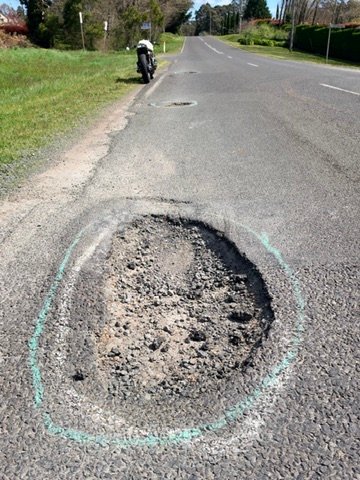
Following Janet’s introduction, I raised a question about the deteriorating condition of roads throughout Hepburn Shire.
My question had two parts.
First, what is Council doing specifically to address the condition of roads under its direct responsibility?
Second, what is Council doing to advocate on behalf of residents for the repair and maintenance of State-managed roads within the municipality?
These are separate responsibilities, but they are closely connected.
Janet explained that State roads are not maintained by Council. That is correct, and I acknowledged the distinction.
However, I suggested that Council also has a broader role in representing the interests of its community, including advocating to the Victorian Government when State-managed infrastructure presents significant safety concerns.
During our subsequent conversation, Janet questioned whether that representative role was reflected in the Local Government Act 2020.
I have since revisited the legislation.
Sections 8 and 9 establish Council’s broader governance role, including promoting community wellbeing, considering the best outcomes for its municipal community and seeking collaboration with other levels of government.
These provisions do not impose a specific obligation to lobby for individual road repairs. They do, however, provide a legislative framework within which Council can advocate for its community.
And that is the distinction I was making.
A resident travelling from Hepburn Springs to Daylesford, Ballarat or Melbourne does not experience Council roads and State roads as separate administrative responsibilities.
We experience one interconnected road network.
It seems reasonable to expect the various authorities responsible for that network to work together, particularly when safety is at stake.
My concern remains that the deterioration of roads throughout our region may have overtaken the priorities established under earlier maintenance programs.
In my view, the situation is approaching the point where it warrants an emergency-style response rather than simply continuing with established maintenance schedules.
That does not mean abandoning existing programs. It means reassessing them against current road conditions, identifying the highest-risk sections and determining whether the planned works are sufficient.
I have been asking for a coordinated recovery program that identifies which roads require attention, what work is proposed, when it will commence and who is responsible.
I also believe residents should be able to access that information without having to navigate multiple government websites and maintenance schedules.
Making information available is not the same as communicating
Hepburn Shire maintains a website, social media channels and a regular newsletter, Hepburn Life.
These are useful resources, but I question whether they are sufficient to keep residents meaningfully informed about important matters affecting their community.
Directing someone to a website may provide access to information, but it does not necessarily answer their question or make them feel included.
Indeed, it can sometimes leave residents feeling that they have been politely fobbed off.
I believe there is an opportunity for Council to adopt a more proactive approach.
Consider the range of issues that regularly attract community interest: road maintenance, significant building developments, changes to planning controls, infrastructure proposals, major Council expenditure and feasibility studies.
Residents should not have to continually search for information about these matters.
And importantly, they should be informed before significant decisions are made, when there is still an opportunity for their views to be considered.
Consultation after a decision has effectively been settled is of limited value.
Communication should lead to participation
There is another important distinction.
Good communication is not simply about telling residents what Council has decided.
It should also provide opportunities for residents to contribute before decisions are finalised.
Council already uses mailchimp. It could potentially be used for targeted issue-specific updates where residents could subscribe for particular issues.
Not every submission will result in a change of direction. Nor should Council be expected to adopt every suggestion.
But residents should have a reasonable opportunity to understand what is proposed, why it is being considered, what it may cost and how their feedback will be assessed.
Council should then explain the decision and, where appropriate, how community input influenced the outcome.
That is how consultation becomes meaningful.
It also creates an opportunity for residents to contribute local knowledge, practical experience and ideas that may not otherwise emerge through formal administrative processes.