

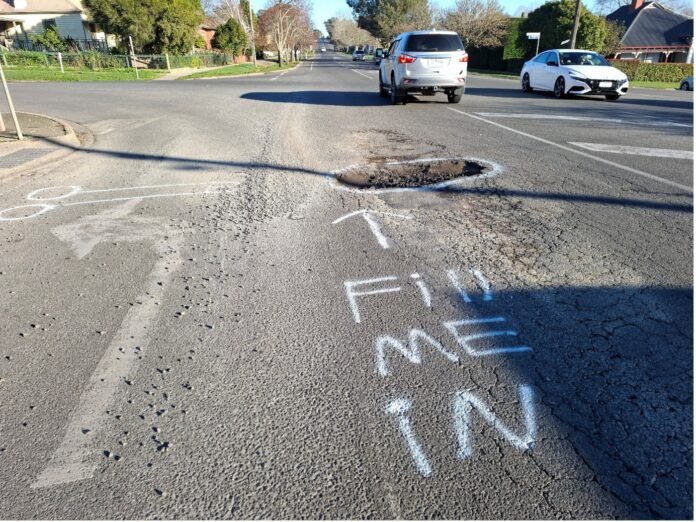
Last week, I wrote in The Wombat Post about the deteriorating condition of our roads and a very simple question I had been putting repeatedly to the Victorian Government:
Where is the road repair plan?
Since then, the issue has taken a tragic and deeply concerning turn.
On Sunday, 71-year-old Ballarat motorcyclist Peter “Tiki” Mason died following a crash on the Western Highway at Trawalla. Victoria Police said emergency services responded to reports that his motorcycle had struck a pothole and lost control. The exact circumstances of the crash remain under investigation.
Mr Mason was president of the Eureka Social Riders and a highly regarded member of the regional motorcycling community. His death has understandably intensified scrutiny of the condition of Victoria’s roads.
As someone who also rides motorcycles throughout Western Victoria, this tragedy hits particularly close to home. What was once principally a discussion about damaged tyres, bent wheels, repair bills and deteriorating infrastructure is now, very clearly, a discussion about road safety.
More interviews. More money. But where is the plan?
Since my first article, Premier Ben Carroll has continued to speak publicly about Victoria’s roads and the Government’s response.
The Government has announced an additional $352 million, saying it will double the number of potholes repaired this year from 250,000 to 500,000. It says the funding will “flow immediately” and has identified major arterials including the Western Highway, Calder Highway, Princes Highway and Geelong Ring Road, as well as regional roads.
Following Peter Mason’s death, the Premier has given further media interviews acknowledging that the Government needs to do better on road maintenance. Speaking on ABC Melbourne, he said it was now “back to basics” on road maintenance and made an important acknowledgement:
“The buck does stop with us.”
That acknowledgement is important.
But every additional interview, announcement and funding figure brings me back to exactly the same question:
Where is the actual delivery plan?
Funding is not a delivery plan
Announcing how much money will be spent is not the same as telling Victorians what will be done, where it will be done and when it will be completed.
For weeks, I have been asking the Premier’s office for relatively straightforward information about how this additional funding will be rolled out across Hepburn, Daylesford, Central Victoria and, increasingly, Western Regional Victoria.
Which roads have been identified?
Which sections will be repaired?
How are they being prioritised?
Will badly deteriorated sections receive another temporary patch, be properly resurfaced, or be reconstructed?
When will the work start?
When will it be finished?
And how will the public be able to track progress?
These are not unreasonable questions. They are the basic elements of any properly managed infrastructure program.
Yet despite numerous emails and telephone calls to the Premier’s office — including being told that my correspondence had been flagged for attention — I still have no substantive answer.
This issue has changed
The death on the Western Highway has transformed the public discussion.
Friends and fellow riders have spoken publicly about their anger and frustration. The message from those who use these roads every day is increasingly clear: something needs to be done.
The issue is now receiving significant television, radio, print and social-media attention, including further interviews and commentary about the condition of Victoria’s roads and the Government’s response.
And the evidence extends well beyond individual complaints.
The Victorian Auditor-General recently delivered a damning assessment of the state road network. It found that around 48 per cent of Victoria’s state roads were in poor or very poor condition in 2024, up from 39 per cent in 2021. It also found that the gap between defects being recorded and defects being repaired more than doubled between January 2025 and June 2026.
Perhaps most relevant to the argument I have been making, the Auditor-General specifically found that the Department’s public reporting does not provide transparency about road condition or the expected impact of maintenance works.
That finding should remove any suggestion that what regional Victorians are experiencing is anecdotal.
We have a systemic problem.
We already know where many of the problems are
One of the challenges often associated with managing such a large road network is identifying and prioritising defects.
But road users are already doing much of that work.
Navigation platforms such as Waze allow motorists to report potholes and road hazards in real time. Local Facebook groups across regional Victoria are filled with photographs, warnings and reports of dangerous sections of road. Councils and state authorities also receive reports directly from motorists.
The Government does not need to start from scratch to understand where many of these problems are.
Nor do Victorians need another mechanism simply to tell government where the potholes are.
What we need to know is:
What happens next?
Give Victorians something they can measure
I am not arguing that every pothole in Victoria can be repaired tomorrow.
Nor am I suggesting that years of deterioration across a vast road network can be reversed in a matter of weeks.
What I am asking for is transparency and accountability.
If the Government has allocated hundreds of millions of additional dollars and says the funding is flowing immediately, there should be a corresponding delivery program that Victorians can see.
At a minimum, it should identify the priority roads and sections, the type of remediation planned, indicative commencement and completion periods, and progress against those commitments.
Ideally, this should be published through a simple online map or dashboard accessible to everyone.
That would allow residents to understand what is happening in their communities. It would allow road users to know where major repairs are scheduled. And, importantly, it would allow taxpayers to judge whether the additional money being announced is actually translating into better and safer roads.
The Auditor-General’s report makes the case for greater transparency even stronger. The Department already holds meaningful information about remaining road life, pavement condition, defect growth, repairs and the maintenance backlog.
So the information exists.
Let Victorians see it.
This is no longer just about Hepburn Shire
When I began raising this issue, my focus was naturally on Hepburn Springs, Daylesford and the roads I use every day.
But the response from people across Western Victoria has made something very clear.
This is not simply a Hepburn Shire problem.
Communities across Western Regional Victoria are describing the same experience: deteriorating surfaces, repeated temporary repairs, damaged vehicles and uncertainty about when meaningful remediation will occur.
And the problem clearly extends beyond Western Victoria. The state of our regional road network is an issue affecting communities across Victoria.
Peter Mason’s death on the Western Highway has brought that wider concern into devastating focus.
My campaign therefore began locally, but the principle I am advocating for applies across Regional Victoria: when the Government announces substantial additional funding and says repairs are commencing immediately, regional Victorians should be able to see where that money is going and when the work will be delivered.
Add your voice
What began as a campaign about the roads around Hepburn Springs and Daylesford is becoming a much broader call for road safety, transparency and accountability across Regional Victoria.
I have launched a petition calling on the Victorian Government to provide a clear, publicly accessible road-repair plan — identifying which roads will be repaired, what work will be undertaken, when it will happen and how progress will be measured.
If you believe regional Victorians deserve those answers, please add your name and share the petition.
Sign the petition — Fix Victoria’s Regional Roads
We’ve heard about the money. Now show us the plan.