

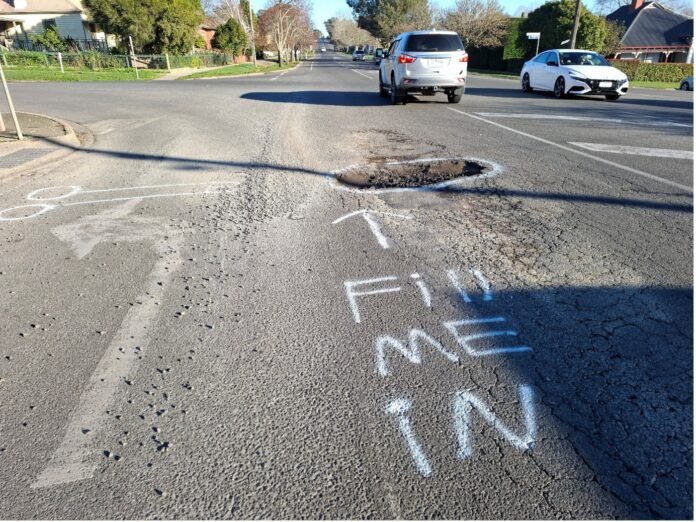
Anyone who regularly drives through Hepburn Shire knows the problem. Potholes, broken road edges, deteriorating surfaces and increasingly patchworked sections of road have become part of everyday driving.
Most reasonable people accept that potholes happen. Roads deteriorate, particularly after sustained wet weather. The issue in Hepburn Shire is no longer the occasional pothole. It is the scale, persistence and apparent deterioration of the network, and the difficulty residents face in finding out what is actually going to be done about it.
My interest in this began with personal experience, including damage to my own vehicle. But after raising the issue on local social media, particularly the Daylesford Grapevine, it quickly became apparent that this was not simply my experience.
The response from residents and road users has been substantial. People have shared photographs, stories of vehicle damage, concerns about dangerous sections of road and considerable frustration at what many see as years of inadequate maintenance.
What I have been trying to establish is actually quite simple.
I am not asking government to tell me which roads belong to Hepburn Shire Council and which are managed by the State. I have already researched that.
I am asking:
What is the plan?
That question has become particularly relevant because Victorian Premier Ben Carroll has been publicly and repeatedly promoting additional funding and accelerated action on potholes and regional roads.
If significant additional funding is being committed and road repairs are being accelerated, residents should reasonably be able to find out what that means in practical terms.
Which roads have been identified for priority attention?
When will work commence in our region?
How are priorities determined?
How much of the announced funding is actually available now?
What determines whether a pothole is simply patched again or whether a badly deteriorated section of road is properly resurfaced or reconstructed?
What are the targets and timelines?
And, importantly, how will the public be able to measure whether these commitments have actually been delivered?
These are not particularly sophisticated questions. They are the sort of basic implementation details that normally sit behind any significant government spending program.
Yet obtaining answers has proven surprisingly difficult.
I initially approached the issue through the normal channels. I wrote to the Premier’s office and to the responsible Victorian Roads Minister seeking implementation details.
The response from the Premier’s office was an automated acknowledgement advising that a reply could take eight to ten weeks.
That struck me as extraordinary when the policy being promoted publicly was described as something that would begin delivering immediately and accelerate over coming weeks.
So I telephoned the Premier’s office.
On my first call I explained that I understood the staff member answering the telephone could not resolve the matter herself and asked, rather than put her in an awkward position, whether I could speak with a supervisor. After some hesitation I was told that a supervisor named Max would call me back that day.
No call came.
I telephoned again the following day and spoke with another staff member. She told me the office does not arrange callbacks. I explained in detail what I had been told the previous day and that no call had been received. She said she would forward my enquiry to the Premier’s office and ask for it to be followed up.
Again, my request was not that the Premier personally telephone me or that every pothole in Hepburn Shire be repaired immediately.
I simply wanted to be directed to the person, department or implementation document that could explain how the Government’s highly publicised road-repair commitment would actually be delivered.
I have also raised the same question publicly on Premier Carroll’s LinkedIn posts promoting the Government’s road initiatives.
At Federal level, the picture is equally significant.
Our Federal Member for Ballarat and Minister for Infrastructure, Transport, Regional Development and Local Government, Catherine King, recently distributed information promoting approximately $45 million in Roads to Recovery funding across the Ballarat region, including $8.525 million for Hepburn Shire Council over the relevant funding period.
I contacted Minister King seeking clarity about how Federal, State and Council funding ultimately translates into road works on the ground.
After receiving the usual automated acknowledgements, I telephoned her office and spoke with a staff member.
The contrast was notable.
The staff member was actually reading my email while we spoke. She understood what I was asking, acknowledged my frustration and agreed that the request was reasonable. She undertook to raise it with the Minister and come back to me.
That is really all I have been asking for throughout this process: engagement with the substance of the question.
I have tried to be patient.
My background includes many years as a senior Australian Government official and diplomat, including appointments as Australian Consul-General and Senior Trade Commissioner in Italy (Milan) and Australian Senior Trade Commissioner to Vietnam (Hanoi).
That experience gave me a reasonable understanding of how government works. I know ministers receive enormous volumes of correspondence. I understand that not every enquiry can receive an immediate ministerial response.
My years living and working overseas have also given me a useful point of comparison. I spent many years in Europe, including Italy, where cold winters, heavy rain, snow and freeze-thaw conditions are hardly unusual. Yet roads are routinely constructed, resurfaced and repaired in those conditions. Weather clearly affects road maintenance, but it cannot reasonably be used as a blanket explanation for the standard we are now seeing across parts of regional Victoria.
To be frank, in my experience many roads in Italy — and even key roads in Vietnam, where I also lived and worked — are maintained to a better standard than some of the roads we are now driving on in regional Victoria. That should concern us. Victoria is a wealthy, developed economy with sophisticated engineering capability. The question should therefore not be whether our climate makes good roads possible, but whether we are funding, designing, maintaining and renewing them adequately.
I also understand the difference between a political announcement and the administrative machinery required to implement it.
Funding needs to be allocated. Projects need to be identified. Priorities need to be established. Contractors and work crews need to be scheduled. Performance needs to be measured.
If a government is in a position to publicly announce substantial additional funding and promote accelerated road repairs, then presumably much of that implementation work either exists or is being developed.
So where is it?
This is not intended as a partisan argument.
Roads are funded and managed through a mixture of Federal, State and local government programs. All three levels have responsibilities, and all three should be accountable for the money they administer.
Nor do I believe residents expect perfect roads.
What they are entitled to expect is transparency.
If millions of dollars of public money are being announced for road repair, communities should be able to understand where that money is going, what work will be undertaken, when it will happen and what outcome taxpayers should expect in return.
The strong response I have received through the Daylesford Grapevine suggests many people across the Shire feel the same way.
Some residents have quite reasonably asked whether governments will simply continue filling individual holes while leaving badly deteriorated and heavily patched road surfaces fundamentally unchanged.
That is precisely why implementation detail matters.
Temporary patching may be entirely appropriate in some circumstances. In others, repeated pothole formation may indicate broader pavement failure, drainage problems or a road surface that has reached the end of its practical life.
Residents do not need to be road engineers to recognise the difference between an occasional repair and a road that is progressively failing.
After repeated correspondence, telephone calls and public requests for information, I have now reached the point where I believe this issue needs greater public scrutiny.
I intend to raise it with other media outlets as necessary, including through contacts developed during my years in government and diplomatic service.
But because this is fundamentally a local issue affecting local residents, businesses, visitors and tourism, I wanted to give the Wombat Post the first opportunity to follow the story.
The question at the centre of it remains remarkably simple:
The money has been announced. The Government says road repairs are a priority. So what exactly is the plan for Hepburn Shire — and when will we see it delivered?
Tim Gauci is a Hepburn Springs resident, business owner and former senior Australian diplomat with extensive experience working within government. He has served as Australian Consul-General and Senior Trade Commissioner in Milan and Senior Trade Commissioner in Hanoi. He is currently advocating for greater transparency and accountability around road repair funding and implementation across Hepburn Shire, following sustained community concern about deteriorating roads and potholes.