

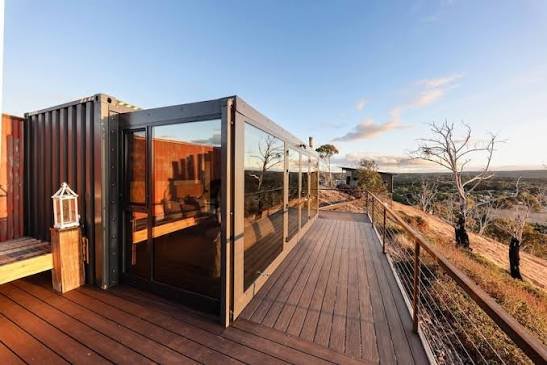
The ABC has conducted an investigation of a lengthy planning dispute involving Clifftop at Hepburn, an upmarket tourism accommodation business co owned by local businessman David Penman. The dispute has kept Hepburn Shire Council in the midst of multiple legal proceedings for over a year, straining council resources and raising questions about development approval processes.
The dispute centres on structures built at the Clifftop villas site overlooking Hepburn Springs, including accommodation units such as Eaglesnest and Jumanji. According to council documents released under Freedom of Information, the site was found to have “extensive additional works” when inspected in early 2024, with officers identifying potential breaches including dwellings built without planning and building approvals, unauthorised signage, lighting, and vegetation removal.
Mr Penman says that the inspection was inappropriate as he had a permit for the site and, “several of those allegations were later withdrawn by Council when they agreed that a building permit was not required for the train or another building. And subsequent caravan park registration by Council regularised many of the remaining issues that are no longer pursued by Council.”
The site is affected by bushfire and environmental overlays—planning tools designed to trigger stricter regulations in sensitive areas. A VCAT filing noted that an earlier glamping proposal on a nearby property, which council twice rejected against officer advice, resulted in restrictions related to the area’s “very high bushfire risk”.
Mr Penman maintains his current operations are lawful. He argues that the site’s caravan park registration complies with regulatory requirements for moveable dwellings, and that secondary consent was an appropriate pathway for the changes. A 2025 social media post by the business acknowledged building Eaglesnest “without council approval,” stating: “When we realised [the council] were never going to approve a villa, we did the only thing left: we built one anyway.”
Mr Penman maintains that the context for the social media comment needs to be understood and that, “our position is not that we knowingly erected something for which we accepted a planning permit was required and simply decided to disregard that requirement. Our position is that the relevant accommodation is situated within a registered caravan park and that, as a moveable dwelling within that use, no separate planning permit was required in the manner Council now alleges.”
He also argues that, ” the permitting process included bushfire assessment of the site. The permitted tourism establishment use remains in place, and our position is that caravan park accommodation is a form of accommodation falling within that permitted use. Further, in registering the caravan park, Hepburn Shire Council considered the regulatory requirements applicable to that registration, including bushfire and wastewater/septic matters.”
The council rejected a 2025 planning application seeking to retrospectively endorse the structures and approve additional yurts and glamping domes under secondary consent. The council stated the structures “cannot be treated as minor, administrative changes” and that a formal planning permit application, with referrals to public agencies including the Country Fire Authority, was required. Mr Penman disputes this requirement.
What began as a planning disagreement escalated into broader legal action. Mr Penman has launched two Supreme Court cases and a VCAT challenge, alleging council bias and questioning the refusal decision.
Most visibly, Mr Penman filed private prosecutions against the then-CEO, mayor, and four councillors—charges related to misconduct in office and budget issues. These charges forced affected councillors to stand down, leaving council without quorum until the Office of Public Prosecutions reviewed the material and found no reasonable prospect of conviction.
The private prosecution charges were dropped in August, and Mr Penman was ordered to pay the defendants’ legal costs. He says he is appealing the cost order to the Supreme Court and that the civil and private prosecution proceedings are not connected.
The ABC investigation found Mr Penman had previously confidentially offered to discontinue the civil cases if the council agreed to a favourable planning outcome and a $450,000 settlement payment.
According to Mr Penman, the planning matter remains before the Supreme Court.
In addition to indicating that he is appealing the cost order against him, Mr Penman also says he has a case before the Supreme Court seekng a judicial review for unlawful expenditure of ratepayer funds on private legal expenses. He says the Court has given him leave to replead the case.
The disputes have taken a significant toll on a small rural council’s resources. In response, the Victorian government is moving to change stand-down laws so that councillors only stand down if charges are brought by law enforcement bodies—a change advocates say will prevent future disruptions to councils across the state.
The council has offered Clifftop at Hepburn advice on how to properly legalise the structures through formal planning processes.