There has been growing discussion in the community about the financial sustainability of Hepburn Shire Council and whether amalgamation with neighbouring councils—or even a break-up of the shire into town-based regions—might offer advantages.
In response, The Wombat Post is beginning a series aimed at helping residents better understand how local government finances work and what potential changes could mean for ratepayers.
This first article looks at a simple but important question: what do Hepburn residents actually pay in municipal rates, what appears on their rates notice, and how might those charges change if council boundaries were redrawn?
The figures presented here are drawn from publicly available information on council websites and published budgets. However, because councils structure their charges differently—some relying more on variable rates while others use fixed municipal charges—direct comparisons are not always straightforward. The figures below should therefore be treated as reasonable approximations rather than precise calculations.
How Councils Calculate Rates
Council rates in Victoria are generally calculated using a property’s Capital Improved Value (CIV) multiplied by a rate-in-the-dollar set annually by each council.
Some councils also apply a municipal charge, which is a fixed amount added to every rates notice regardless of property value.
For the 2025–26 financial year, the residential rates set by nearby councils are approximately:
| Council | Residential rate |
| City of Ballarat | 0.0029921 |
| Hepburn Shire Council | ~0.00241 |
| Mount Alexander Shire Council | ~0.002398 |
| Golden Plains Shire Council | ~0.002111 |
| Moorabool Shire Council | ~0.00205 |
| Macedon Ranges Shire Council | 0.00196540 |
Golden Plains and Macedon Ranges also apply a municipal charge of around $200–$210, added to the calculated rate.
What the Variable Rate Looks Like
To illustrate how these multipliers affect individual ratepayers, the table below shows the general rate only (before additional charges) for properties of different values.
| Property value | Hepburn | Mt Alexander | Macedon Ranges | Ballarat | Golden Plains | Moorabool |
| $500,000 | $1,206 | $1,199 | $983 | $1,496 | $1,056 | $1,025 |
| $700,000 | $1,688 | $1,679 | $1,376 | $2,094 | $1,478 | $1,435 |
| $1,000,000 | $2,414 | $2,398 | $1,965 | $2,992 | $2,111 | $2,050 |
| $1,200,000 | $2,897 | $2,878 | $2,358 | $3,590 | $2,533 | $2,460 |
These figures represent only the core rate component. What most residents see on their final bill is higher because several additional charges are added.
What Else Appears on a Rates Notice?
Most Victorian rates notices include a number of additional charges.
Some—such as the Emergency Services and Volunteers Fund levy—are imposed by the State Government and do not go to the council.
Typical charges include:
| Charge | Hepburn | Mt Alexander | Macedon Ranges | Ballarat | Golden Plains | Moorabool |
| Waste service charge | ~$350–$450 | ~$450 | ~$450 | $606 | $447 | ~$450 |
| Waste management charge | $230 | included | included | included | included | included |
| Municipal charge | none/minor | small | ~$210 | none | $200 | small |
| Emergency Services levy | ~$130–$200 | ~$130–$200 | ~$130–$200 | ~$230 | ~$130–$200 | ~$130–$200 |
Notably, Hepburn appears to be the only council in this group that separates a $230 waste management charge in addition to the bin collection service fee.
What a Typical Rates Notice Might Look Like
When these additional charges are included, a reasonable estimate of the total annual rates bill for different property values emerges.
| Property value | Hepburn | Mt Alexander | Macedon Ranges | Ballarat | Golden Plains | Moorabool |
| $500k | ~$1,900 | ~$1,850 | ~$1,750 | ~$2,330 | ~$1,830 | ~$1,900 |
| $700k | ~$2,380 | ~$2,330 | ~$2,150 | ~$2,930 | ~$2,250 | ~$2,310 |
| $1M | ~$3,100 | ~$3,050 | ~$2,740 | ~$3,830 | ~$2,880 | ~$2,930 |
| $1.2M | ~$3,580 | ~$3,530 | ~$3,130 | ~$4,430 | ~$3,300 | ~$3,340 |
What the Comparison Suggests
This comparison reflects what a typical property owner might pay, not necessarily the value or scope of services provided by each council.
For example, if Hepburn were amalgamated with Ballarat, a property valued at around $1 million could see a rates increase in the order of 20–25 per cent compared with current Hepburn rates.
However, such a change would also bring different service levels, infrastructure responsibilities and governance arrangements across a larger municipality.
More to Come
Understanding council finances is not simply about the size of the rates notice. It also involves understanding what services councils deliver, how infrastructure is funded, and how costs are shared across communities.
The Wombat Post encourages residents to take an interest in how their rates are calculated and spent.
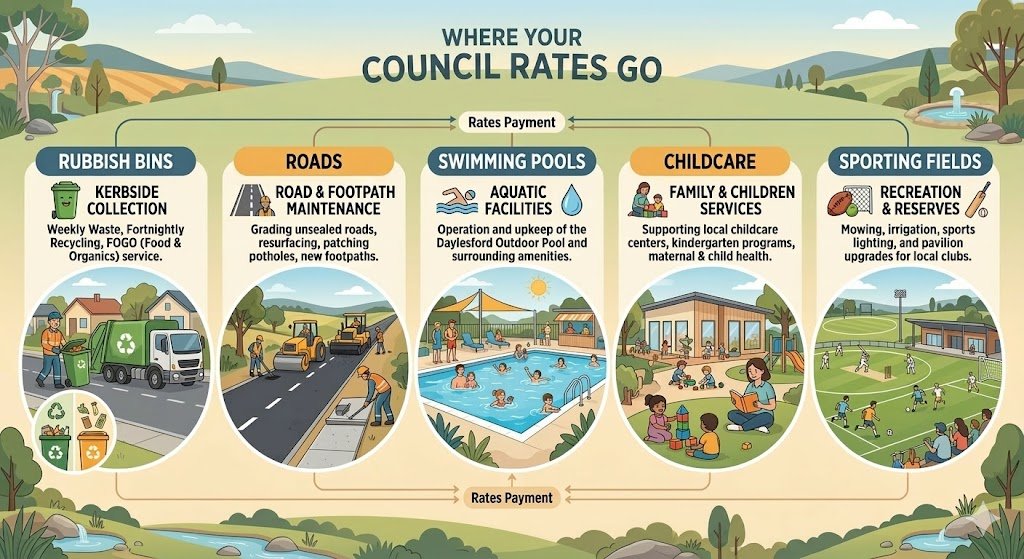
Future articles in this series will examine where council money goes, the costs of maintaining infrastructure across the shire, and what realistic options exist if structural change to local government in the region is considered.