

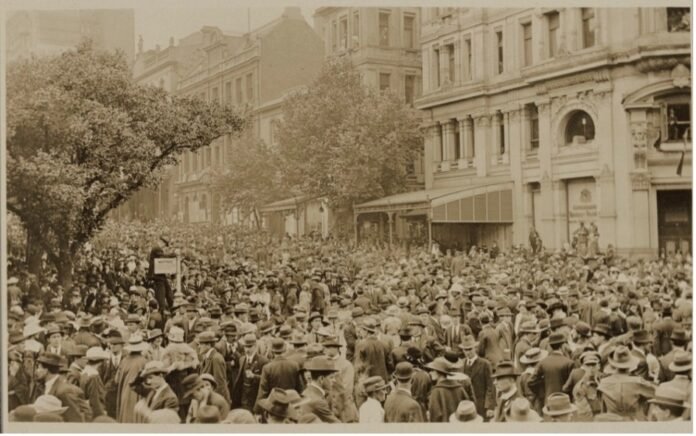
In these days of instant communication, across the world, we forget how slow news was in filtering down to our region – even for such outstanding events as the end of World War One.
From The Daylesford Advocate, Yandoit, Glenlyon and Eganstown Chronicle of Wednesday 13 November 1918:
DAYLESFORD RESIDENTS REJOICE
Nowhere throughout the Commonwealth was the news of the Germans’ acceptance of Marshal Foch’s terms for an armistice more eagerly anticipated and anxiously awaited than in Daylesford, and when on Monday night the good news came through – well to use the words of one gentleman – the citizens “rejoiced some”.
The fathers of the city “were met within their hall” transacting the business of the ratepayer, when at about a quarter to nine o’clock, Mr. R.W. Shellard , solicitor, entered the chamber and handed to Mayor Densem a ‘Herald’ containing the information that the Kaiser, after abdicating, had fled to Holland, and that official confirmation of an armistice was expected at any moment. Councillors visibly wavered in their attention to business. A few minutes later Mr. Shellard again appeared and announced that Mr. Tyler, draper, of Ballarat, had phoned to Mr. W. Johnston, his Daylesford manager, that an armistice was an accomplished fact.
Councillors began to move anxiously in their chairs. A few seconds subsequent and a loud knocking resounded at the chamber door; it opened and Caretaker J. Birt explained that Miss Lynda Brown had received “a phone message from Ballarat Courier” that an armistice was signed. Councillors were unanimously of the opinion that the only course open was to adjourn, and they did so for a week, after passing accounts.
Mayor Densem had arranged with Hon. D. McLeod, M.L.A., and the Hon. E.Jowett M.H.R. that they should wire him as soon as there was an official declaration of an armistice, It was, of course, too late to receive a wire, but all were hopeful that a ‘phone message would come through.
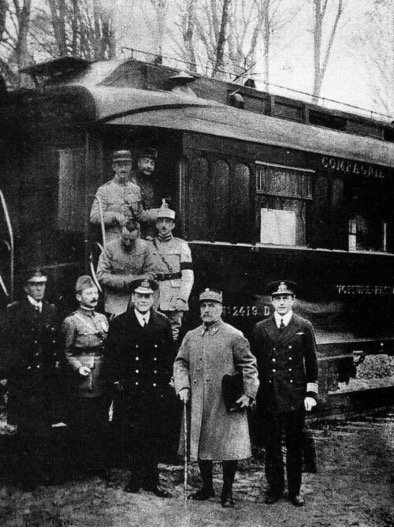
The signatories of The Armistice 1918
Source: Wikipedia
When councillors joined the crowd that had assembled in the street Mayor Denem was anxiously besought for a sign that would sanction the ringing of the bells at the two fire stations and the churches. He, however, intimated that he could not give one until he had some official notification. There were loud murmurings especially on the part of the ladies. “Oh ‘phone to Bullarto,” exclaimed one sweet enthusiast, “the people there are bound to know”. The sally caused much laughter. Mayor Densem endeavored to get “The Argus” office on the ’phone.
Meanwhile, a message from ‘The Kyneton Guardian’ to ‘The Advocate’ office announced that a Reuter cable message received there had stated that news received via Vancouver had intimated that an armistice had been signed and that this news had been confirmed via Washington. Mayor Densem was dubious about accepting this information seeing that an erroneous message from Vancouver had on Friday stted the achievement of peace, moreover he had received word from the post office that as soon as the official announcement of the armistice occurred the information would be wired to all post offices throughout the Commonwealth.
Finally, however, just before eleven o’clock, the mayor obtained ‘phone connection with ‘The Argus’ office and learned that though there had at that time been no official declaration, the armistice was an accomplished fact. He thereupon, from the upstairs portico of the Town Hall, announced to a large crowd assembled below, the glad tidings. There was great cheering and ‘God Save the King’ was sung. At 11.50 p.m. Mr Webster, the local postmaster, received the official wire that the armistice had been signed at 5 o’clock on Monday morning which would be equal to 3 o’clock p.m. in Victoria.
There was intense excitement on all sides. The Town and Wombat Hill fire bells and those at Christ Church and St. Andrew’s Church were vigorously rung, the whistles at the mines shrieked shrill and loud, fireworks were discharged, tin whistles, various wind instruments and the big drum of the local brass band, hand bells of all sizes, tins of all descriptions, and anything that could make a noise were brought into requisition. Arm-in-arm an excited throng “a noble army, men and boys, the matron and the maid”, they paraded Vincent Street, up Howe Street as far as The Advocate office, and then back to the Town Hall, which meanwhile had been lit up.
The doors were thrown open and the crowd surged in. The balcony and body of the hall were soon filled and the scene was very inspiring. Many carried bannerets and all were happy and jolly and enthusiastic. … They continued their rejoicing in the streets, but gradually the sounds subsided until with a final clang of the fire bell between one and two in the morning, they died away.
From the archives of The National Library of Australia