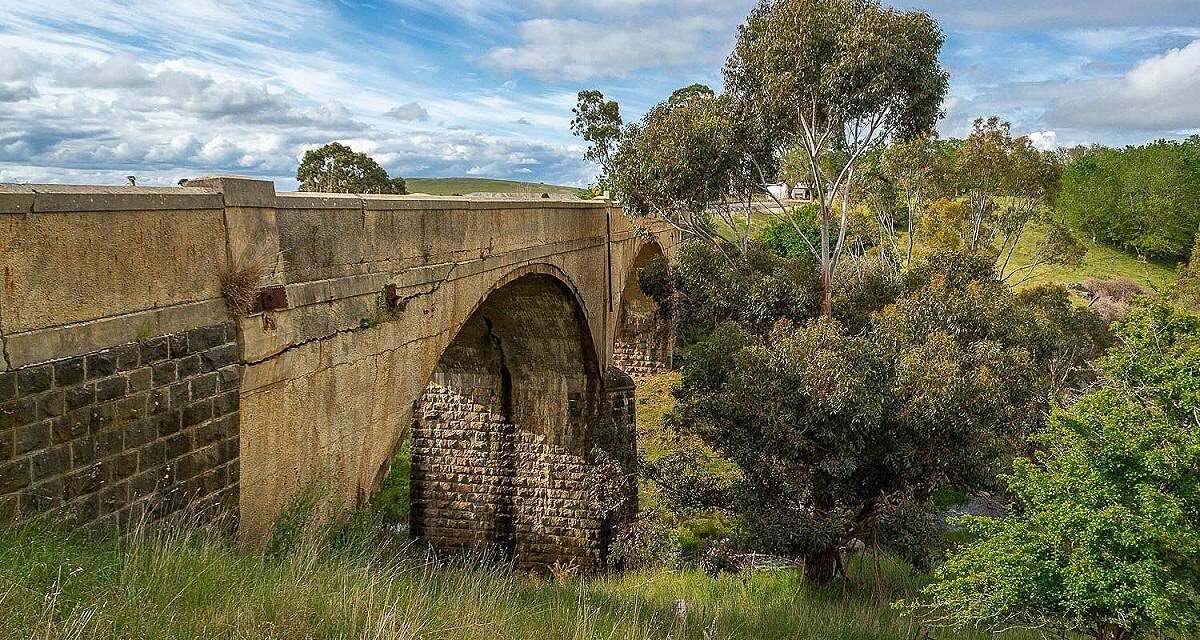
Hepburn Shire Council will next week consider a recommendation to permanently close Wheelers Bridge at Lawrence, citing significant safety risks and an escalating renewal cost that could approach $10 million.
The 125-year-old bridge over Birch Creek on Creswick-Lawrence Road was constructed in 1900 by Monash and Anderson using the then innovative Monier system of reinforced concrete. It was the third Monier bridge built in Victoria and is now the oldest of its type still operating as a road bridge in the state. The bridge is listed on the National Trust of Australia (Victoria) register and in the Hepburn Planning Scheme.
The Monier system, developed in France in the 19th century, used steel reinforcement embedded in concrete, a technology that would become central to modern civil engineering. One half of the firm, John Monash, later Sir John Monash, went on to achieve national prominence as both an engineer and commander of Australian forces in the First World War. His early work on bridges such as Wheelers Bridge helped establish his reputation as a pioneer of reinforced concrete construction in Australia.
However, age and structural shortcomings dating back to the time of construction have taken their toll.
A 15-tonne load limit was imposed in 2013 following condition assessments. In 2018 the bridge was reduced to a single lane with a 40 km/h speed limit, and sensors were installed to monitor movement. While monitoring in 2020 showed no material shift, a recent independent engineering review in December 2025 deemed the structure “immediately dangerous”. Council implemented an interim closure soon after.
Officers now recommend permanent closure to both vehicles and pedestrians.
Council had previously pursued a renewal project retaining the heritage structure. Initial construction estimates were around $3.6–4 million, supported by a $2.78 million federal grant under the Bridges Renewal Program on an 80:20 funding split. Council also allocated $507,453 for road approach works.
But a 2025 Expression of Interest process revealed construction estimates up to 100 per cent above the available budget. Total project costs, including contingencies and management, are now estimated in the order of $9–10 million, a figure equivalent to roughly a decade of Council’s projected bridge renewal spending.
Federal funding cannot exceed 80 per cent of eligible costs and is capped at $5 million, leaving a shortfall of $4–5 million. No additional funding sources have been identified.
Alternative options, including reducing the scope of works, pedestrian-only access, seeking further grants or constructing a duplicate bridge, were assessed and found either unsafe, financially unviable or both.
Under the recommended option, Council would formally close the bridge, install barriers and signage, construct vehicle turnaround points and include interpretive signage recognising the site’s historic significance. Approximately $200,000 of Council’s allocated contribution would fund the closure works, with remaining funds returned to general revenue. The associated road upgrade would be removed from the current capital works program and funds reallocated.
The closure requires detours of approximately 9 km for regular and emergency vehicles and 13 km for heavy vehicles. Eleven properties are directly affected. Average daily traffic on the road was recorded at 77 vehicles in 2021. Heavy vehicles have already been detouring since the 15-tonne limit was introduced.
Council officers acknowledge the disappointment the closure will cause, particularly given the bridge’s heritage value and its association with Sir John Monash. The report proposes future investigation of a visitor experience area, potentially supported by external grants, to recognise the bridge’s historical importance.
Council will consider the recommendation at its Ordinary Meeting on 24 February 2026.